
The peaceful, safe and sustainable development of the Moon requires law and policy as much as it needs technology and engineering.
Our Mission is to create a conducive policy environment for a peaceful, prosperous and collaborative future on the Moon, based on three pillars: policy development, policy implementation, and policy education.
-
Policies & Standards
Under our Lunar Policy Decalogue, we facilitate the cooperative setting and implementation of policies and standards for peaceful, safe, and sustainable lunar activities.
-
Priorities & Trends
Through our Reports & Snapshots we identify common ground among all stakeholders around priorities and trends to focus and shape the development of policies & standards.
-
Commentaries & Seminars
Through our Commentaries and Seminars we educate the global space community on key legal and policy issues, contributing to building capacity in lunar policy.

Policies & Standards
Building upon the common ground identified in the Lunar Policy Priorities Report, LPP is working with stakeholders from the global space community on
the realisation of a Lunar Policy Decalogue.
The Lunar Policy Decalogue is a set of ten deliverables enabling and accompanying the peaceful, safe,
and sustainable development of the Moon.
Each year, depending on ongoing developments, availability of funding, and community interests,
LPP will work to develop one or more deliverables from the Decalogue, ultimately aiming to complete
a first draft of all its elements at the latest by 2035.
The Lunar Policy Decalogue
Policies and Standards
So far LPP has released policies and standards in three areas: lunar nuclear reactors (2026),
lunar information sharing (2025), and lunar science & ethics (2025).
The relevant policy Reports can be found below.
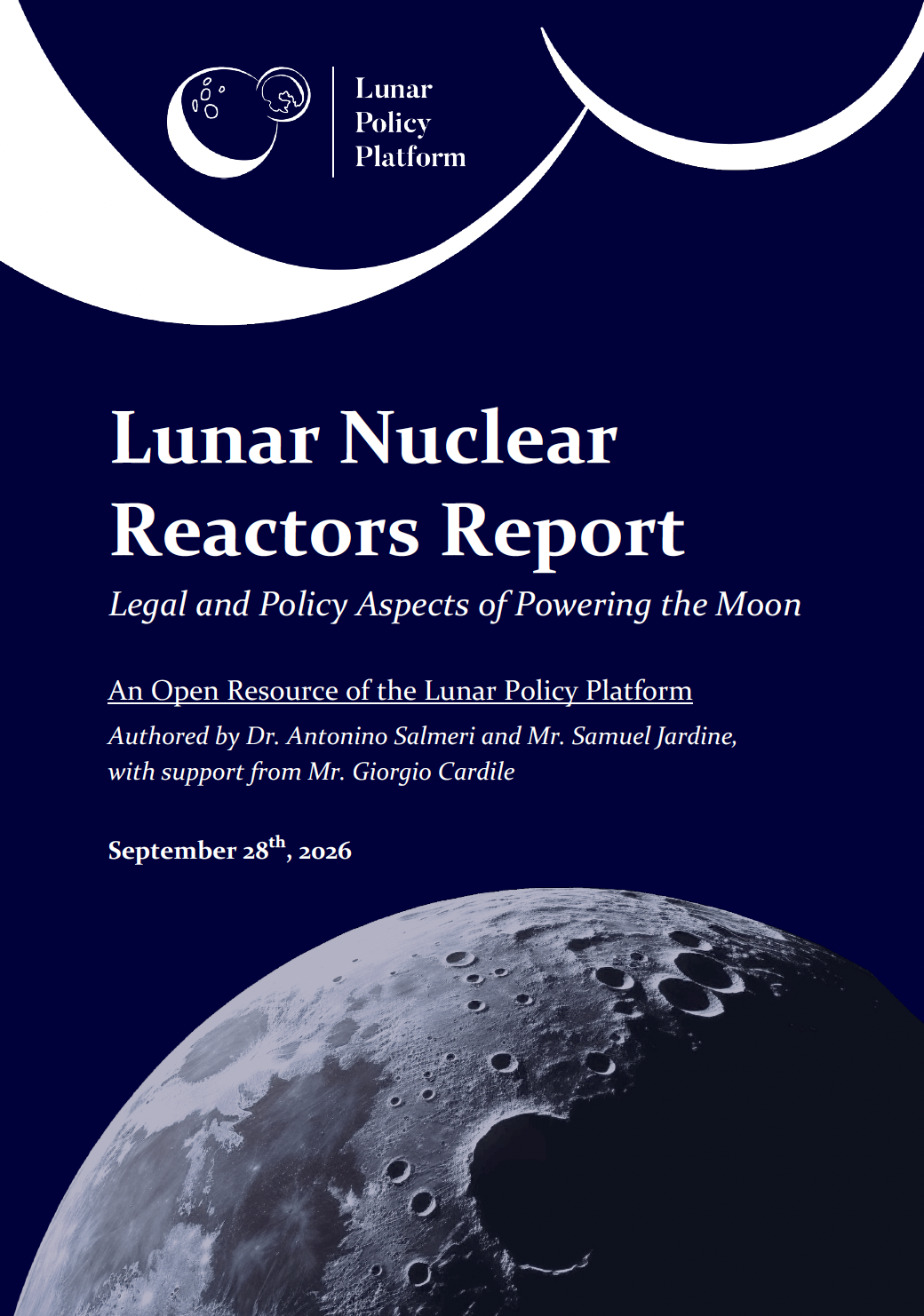
Lunar Nuclear Reactors (2026)
Lunar Information Sharing (2025)

The Lunar Information Sharing 101 is the first and only document identifying common ground on core elements, guiding principles, and streamlined practices for lunar information sharing, based upon 6 months of extensive global consultations featuring over 35 governments,
space agencies, lunar companies, and experts.
The LIS 101 is divided in 4 Parts:
Part I presents background information on LPP and outlines goals, structure, vision and methodology.
Part II identifies convergence and divergence on purposes, legal bases, mechanisms, stakeholders, and limitations.
Part III presents common ground on a working definition, guiding principles, and streamlined practices on what to share, where, how, and when, including a template.
Part IV concludes by summarising key takeaways
and outlining next steps for implementation.
Lunar Science & Ethics (2025)

The Guide to Lunar Science and Ethics is the first document identifying key scientific, cultural, and ethical interests in lunar exploration, and assess a path forward for a balanced approach based upon 6 months of extensive global consultations with key scientific institutions
and civil society entities worldwide.
The GLES is divided in 4 Parts:
Part I presents background information on LPP and outlines goals, structure, vision and methodology.
Part II presents key scientific, cultural and ethical interests, including an overview of potentially competing ones.
Part III outlines a variety of requirements suggested by stakeholders to preserve the interests identified in Part I, presents fragmentation gaps, and concludes with an analysis on convergence and divergence.
Part IV concludes by summarising key takeaways and proposing baseline suggestions on due regard, foundational principles and practices to continue the conversation.
The Lunar Nuclear Reactors Report (LNRR) is the first and only document identifying views and concerns on legal and policy aspects of nuclear reactors on the Moon.
The LNRR has been developed based upon 9 months
of global consultations with 79 stakeholders from all six continents, including governments, space agencies,
lunar companies, nuclear experts, and civil society.
The LNRR is divided in 4 Parts:
Part I presents background information on LPP and outlines goals, structure, vision and methodology.
Part II presents the views and concerns of stakeholders
on the legal and policy aspects of lunar nuclear reactors.
Part III assesses common ground and divergencies between the views of stakeholders, identifies cross cutting tensions and implications, and extracts key takeaways.
Part IV concludes by presenting seven action oriented recommendations for a shared way forward.

Looking ahead at 2026, in September 2025 LPP has developed and distributed a draft policy plan to outline areas of work for the year to come.
Following LPP’s action-oriented approach, the Plan is structured in 3 Parts: policy development, policy implementation, and policy education.
Within each Part, the Plan outlines specific areas that LPP would like to address, the concrete deliverables
it could produce, and the resources required to do so.
LPP firmly believes that all lunar policy activities, from development to implementation passing through education, are best undertaken as a global, collaborative and multi-stakeholder effort.
Any organisation interested in collaborating with LPP on the realisation of the 2026 policy plan, is warmly invited to contact the LPP Team at lpp@lunarpolicyplatform.org
Lunar Policy Plans
Trends & Priorities

Lunar Policy Priorities Report

The Lunar Policy Priorities Report identifies ten priority areas to be addressed for the safe and sustainable development of the Moon,
based upon a rigorous consultative process involving 40
stakeholders from the global space community,
On November 11th, 2023, the LPP officially unveiled the Lunar Policy Priorities Report at the Palais Brongniart in Paris through a dedicated panel discussion on lunar policy at the occasion of the 6th Paris Peace Forum (PPF).

Lunar Policy Snapshots
The Lunar Policy Snapshot is an original series of policy documents developed by LPP at the end of every given year.
The goal is to provide a focused and comprehensive picture of key developments occurring each year, outline stakeholder views,
capture the status quo of the policy ecosystem, and assess critical implications on policymaking for the year to come.
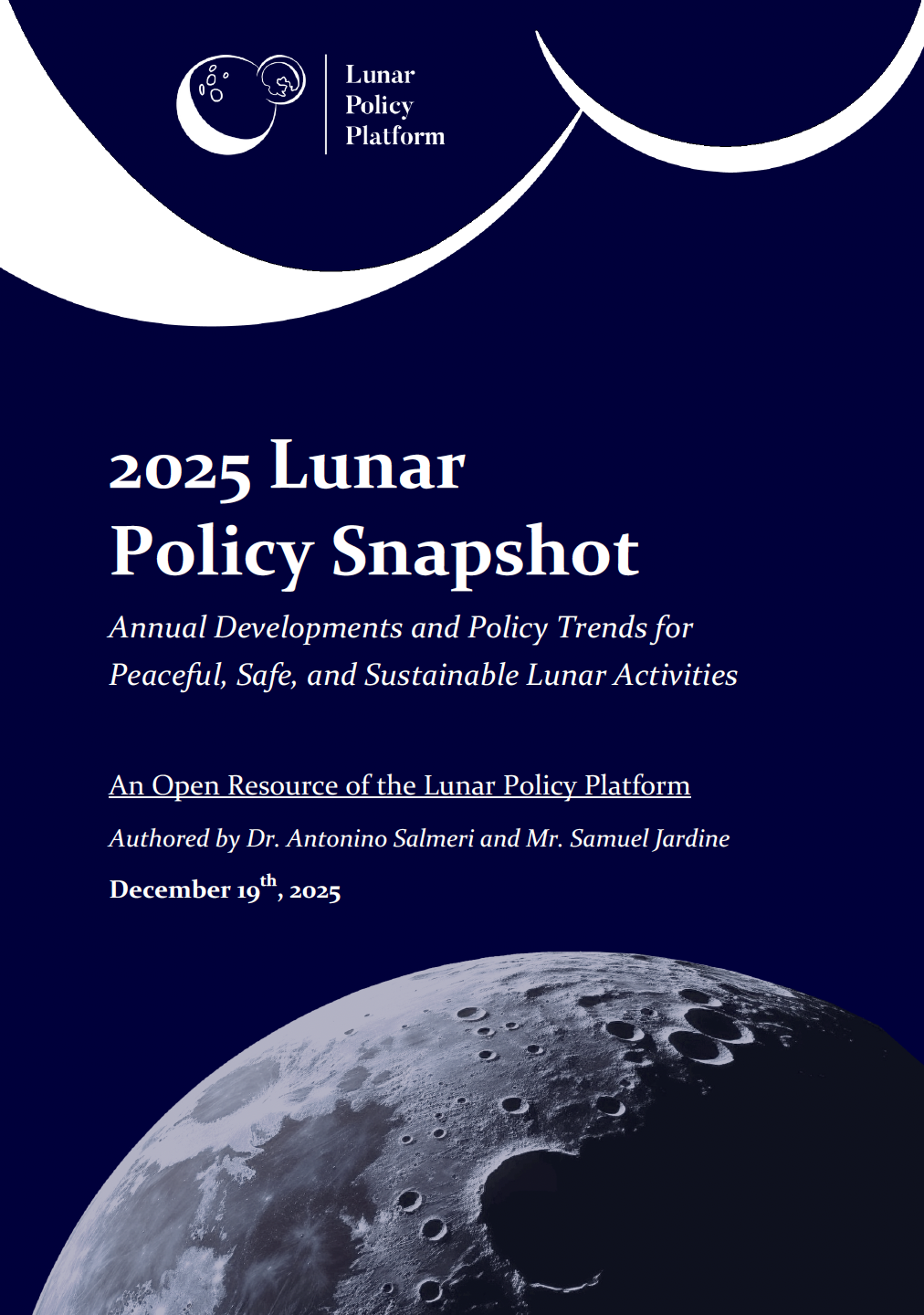
The 2025 Snapshot maintains the same concise style of the 2024 edition and enriches its classic tripartite structure featuring key developments, stakeholder views, and policy assessment, adding an ecosystem analysis to close knowledge gaps and validate trends.
The 2025 Snapshot is based on the insights gained by LPP via policy consultations with 58 stakeholders, participation in 10 global conferences and the annual COPUOS sessions, organisation of a Lunar Community Workshop with the Royal Astronomical Society and the UK Space Agency, co-hosting of an Online Seminar Series on Safe and Sustainable Lunar Activities with the Korea Aerospace Research Institute, and more.
The 2025 Snapshot has been developed with funding from the Open Lunar Foundation and can be freely accessed and used by all stakeholders in perpetuity.
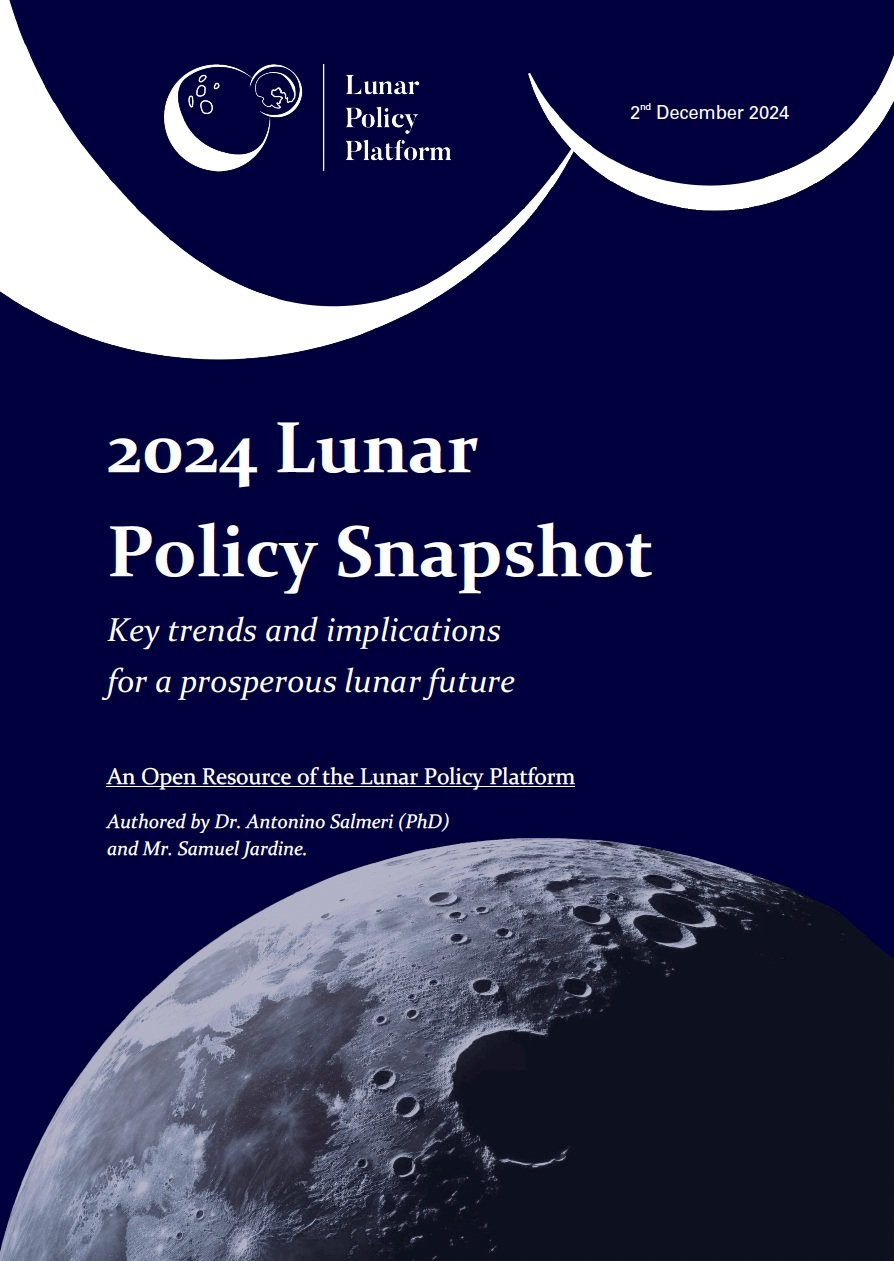
The 2024 Snapshot was the first one in the Series, inaugurating its classic tripartite structure outlining lunar related developments and the views of stakeholders,
and assessing main policy implications for the year to come.
This Snapshot was based over three months of dedicated consultations with over forty stakeholders from all over the world to validate the structure of the documents and gain insights concerning lunar policy developments, also due to the absence of previous policy consultations conducted in 2024, when LPP focused on institutional development.
The 2024 Snapshot has been developed with funding from the Open Lunar Foundation and can be freely accessed and used by all stakeholders in perpetuity.
Commentaries & Seminars
Launch Event of the
Guide to Lunar Science & Ethics
Launch Event
September 18th, 2025
Lifting the Moon Fog: Information Sharing for Lunar Peace, Safety, and Sustainability
Op-Ed
September 14th, 2025
One Moon, Many Interests:
Can We Make Space for All?
Op-Ed
July 23rd, 2025

Lunar Policy for a
Thriving Lunar Economy
Seminar
June 2nd, 2025
All Eyes on the Moon: Sharing Information for Lunar Peace, Safety and Sustainability
Op-Ed
June 27th, 2025

Moon Rise or Moon Fall? Policy Trends
and Futures in a Changing Landscape
Op-Ed
December 5th, 2024

Launch Event of the
Lunar Information Sharing 101
Launch Event
August 19th, 2025
About LPP Foundation
-
Status
LPP Foundation is a non-profit, non-governmental organisation registered in The Netherlands as a “Stichting”, which is the Dutch word for “Foundation”.
-
Address
LPP Foundation is located in Amsterdam
at Weesperstraat 107, 1018VN,
The Netherlands. -
Governance
LPP Foundation is managed by a Board of Directors, composed of Dr. Antonino Salmeri as Chairman and
Mr. Samuel Jardine as Secretary.